A / Processing
Audio platform
The system is built around the Daisy Seed. Its platform provides a 480 MHz Arm Cortex-M7 processor and stereo 24-bit / 96 kHz audio hardware—headroom for real-time musical DSP in an embedded format.
(01)Flagship project / Embedded audio← Project index
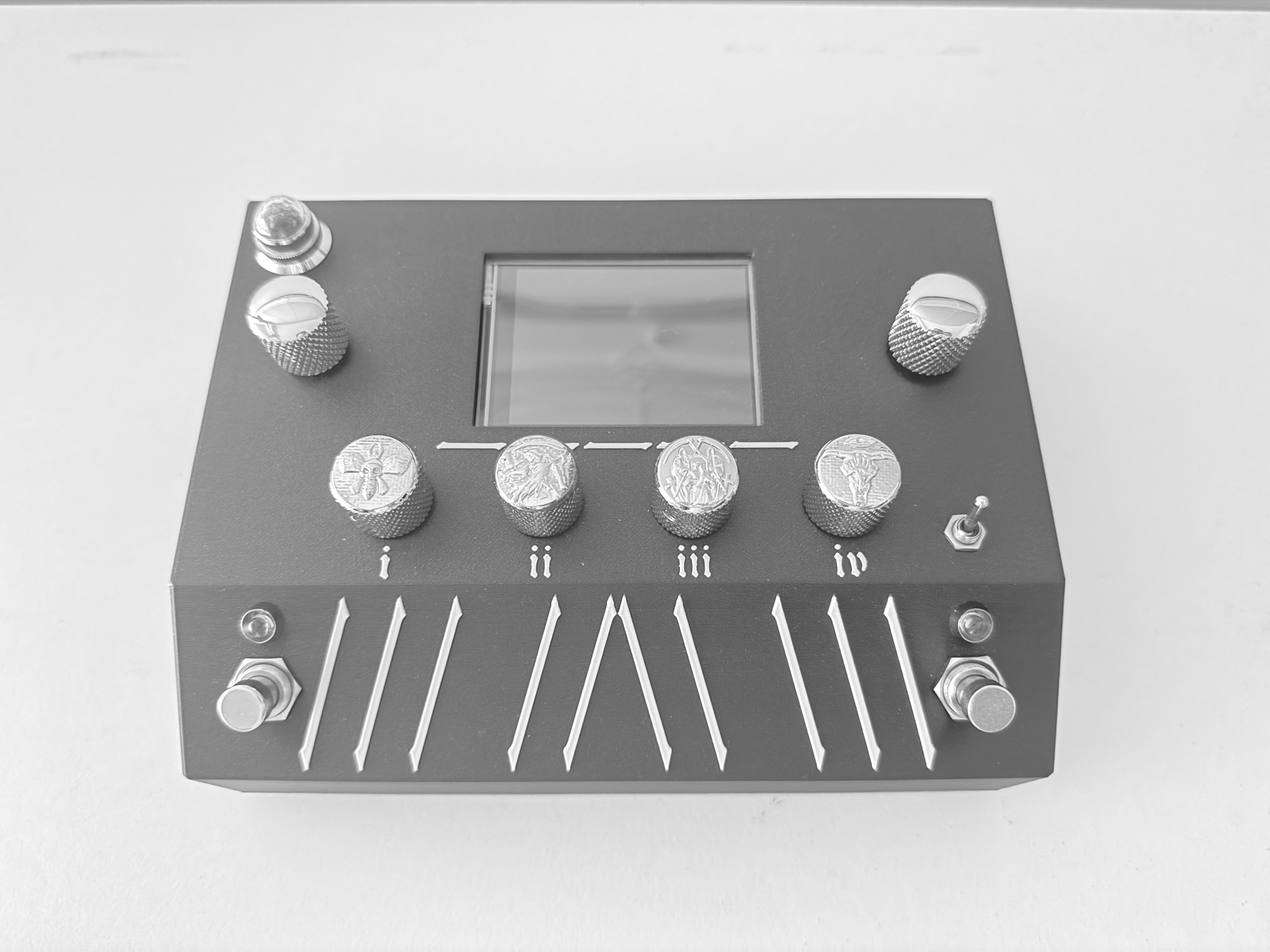
Digital multi-effects processor
Ten guitar effects, one combinable signal chain, and a compact touchscreen interface—engineered as an upgradable instrument rather than a fixed-function pedal.
| Ownership | End-to-end independent development |
|---|---|
| Audio engine | 10 combinable effect blocks |
| Controls | Touchscreen, 4 knobs, 2 footswitches |
| I/O | 2 inputs / 2 outputs |
| Power | USB-B or dedicated power jack |
| Enclosure | Custom 3D-printed housing |
| Status | Working, continuously upgradable prototype |
(02)Design premise
BonesFX began with a demanding product question: how can a single floor device provide the range of a multi-pedal rig without turning the musician’s interaction into menu navigation?
The answer is a ten-block digital effects chain. Distortion, overdrive, flanger, phaser, pitch shifting, and additional effects can be active simultaneously in different combinations. The screen communicates the current state; four physical knobs adapt to the selected effect; and two footswitches keep essential performance actions underfoot.
Upgrade access is part of the system architecture, not an afterthought. SD-card and USB-C interfaces make factory updates possible for the Nextion display and device experience, allowing both the interface and the effect set to continue improving. BonesFX grows with the engineering behind it.
(03)System architectureHardware + firmware + interaction
A / Processing
The system is built around the Daisy Seed. Its platform provides a 480 MHz Arm Cortex-M7 processor and stereo 24-bit / 96 kHz audio hardware—headroom for real-time musical DSP in an embedded format.
B / Control
A Nextion touchscreen supplies visual state and effect selection. Four context-aware knobs control whichever effect is active, reducing panel density without removing tactile adjustment.
C / Performance
Two footswitches can toggle effects or operate momentarily, keeping the unit practical on the floor while expanding the interaction beyond simple on/off behavior.
D / Routing
Two inputs and two outputs support a two-channel audio path inside a single enclosure, widening the system beyond a conventional mono stompbox format.
E / Power
The device can be powered through USB-B or a dedicated power jack, making it usable in both development and pedalboard-oriented contexts.
F / Lifecycle
Accessible SD-card and USB-C connections make the interface and device software serviceable as the project develops instead of freezing the hardware at one revision.
(04)Product design
The enclosure deliberately avoids the visual conventions of hobby electronics. A repeating pointed “bone” pattern gives the front surface a gothic rhythm, while the black finish, controlled geometry, flush screen, and sparse hardware keep it contemporary.
This aesthetic is functional as well as expressive: the screen dominates the information layer, the four knobs form a readable control group, and the two footswitches occupy the high-impact performance zone. The enclosure was 3D printed, finished, populated, wired, and assembled as part of the same development process.
BonesFX combines embedded audio, interface architecture, update strategy, I/O planning, mechanical packaging, and visual design. The result behaves as one product because every layer was developed together.
(05)Hardware recordClick to enlarge
Upgradability turns one finished build into a platform.
The enclosure can remain on the floor while the effects, interface, and operating experience continue to mature. That lifecycle thinking is the central engineering decision in BonesFX.