A / Input
Eight independent switches
Each footswitch is read as a separate control, allowing any software action that accepts MIDI input to be mapped to the physical layout.
(02)Project / Embedded control← Project index
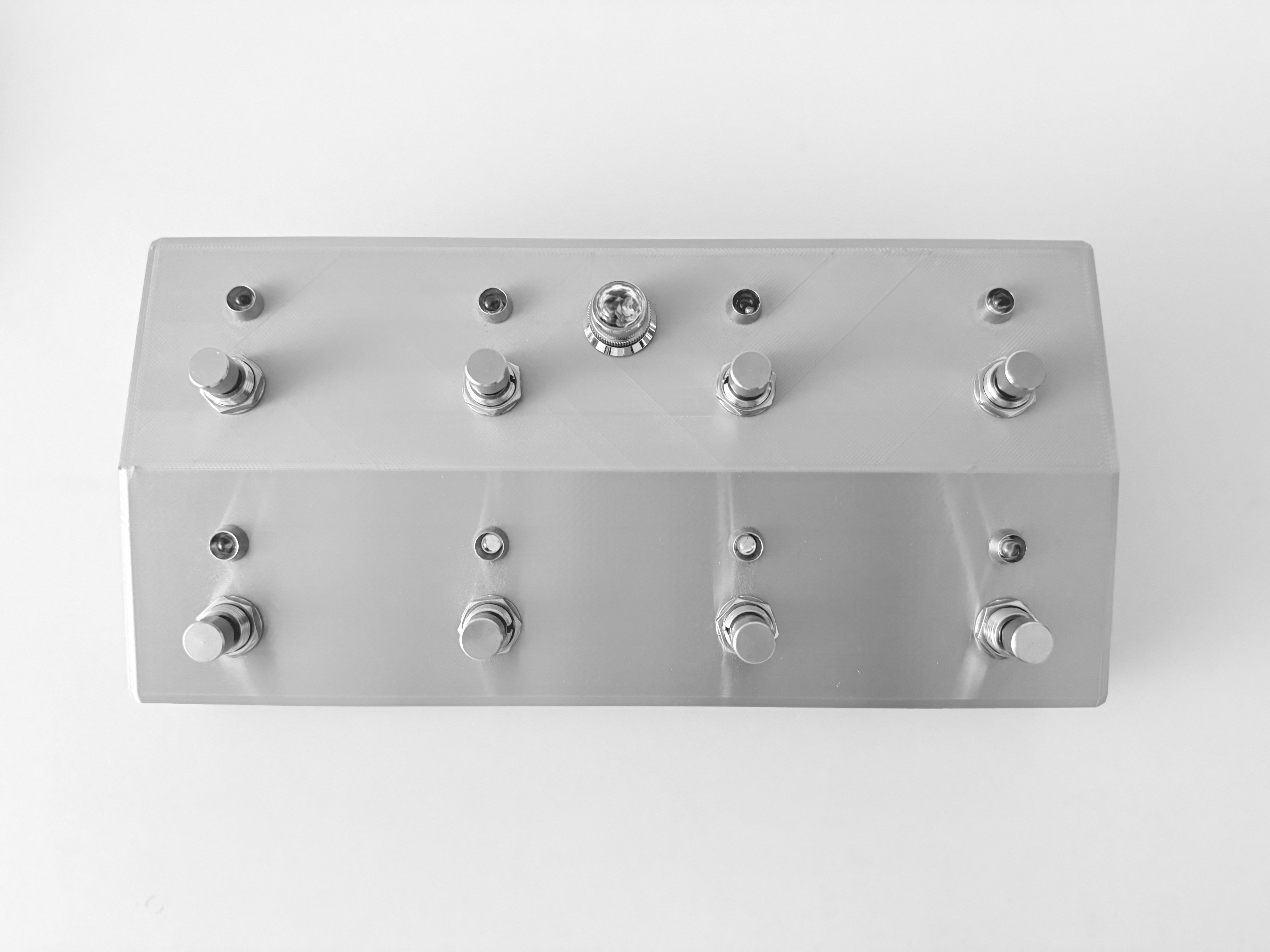
USB MIDI floor controller
Eight programmable controls for a computer-based music setup, with every switch independently configurable as momentary or latching.
| Ownership | Independent electronics, firmware, enclosure, and assembly |
|---|---|
| Controller | Arduino Pro Micro |
| Inputs | 8 metal footswitches |
| Configuration | Per-button momentary / latching mode |
| Connection | USB-C MIDI to computer |
| Enclosure | 3D printed, metal-like texture |
| Status | Working device |
(01)Design problem
Computer-based music rigs can map almost any action to MIDI, but controlling them with a mouse breaks the physical flow of playing. This footswitch turns eight common software actions into controls that can be reached without taking either hand off the instrument.
The challenge was not simply adding eight buttons. Different software commands expect different kinds of input: some should toggle and hold their state, while others should remain active only while the performer holds the switch. The device makes that behavior configurable without reflashing the controller.
(02)Engineering decisionsFlexible at the hardware level
A / Input
Each footswitch is read as a separate control, allowing any software action that accepts MIDI input to be mapped to the physical layout.
B / Mode logic
An eight-position DIP switch mirrors the eight footswitches. Each pole selects whether its corresponding control behaves momentarily or latches.
C / USB
The Arduino Pro Micro sends MIDI to the host through USB-C, keeping the device compact and straightforward to deploy with a computer.
D / Firmware
The control logic interprets the configuration before transmitting MIDI, so mixed momentary and latching behavior can coexist in any combination.
E / Mechanics
The enclosure gives eight switches enough separation for deliberate foot operation while maintaining a minimal rectangular footprint.
F / Finish
A custom 3D-printed enclosure uses a metal-like surface texture and restrained geometry to read as equipment, not a desktop prototype.
(03)Interaction design
The rear DIP switch is a compact hardware interface for a firmware behavior. Its one-to-one relationship with the eight footswitches makes the setup legible: one switch configures one control. A player can build a mixed layout—for example, sustained actions beside toggled actions—without connecting a programmer or opening software.
The visual design keeps attention on the operating surface. Eight identical actuators establish a clear rhythm; the silver metal-like texture gives the printed enclosure a more durable visual character; and all configuration detail moves to the rear panel.
(04)Hardware recordClick to enlarge
Eight controls. Two behaviors each. Any combination.
The most important feature is not the switch count; it is the ability to shape each switch around the software action it controls.