A / Surface
Sixteen knobs
A four-by-four control matrix provides enough physical resolution for simultaneous adjustment while keeping every parameter within one hand’s reach.
(04)Project / First complete build← Project index
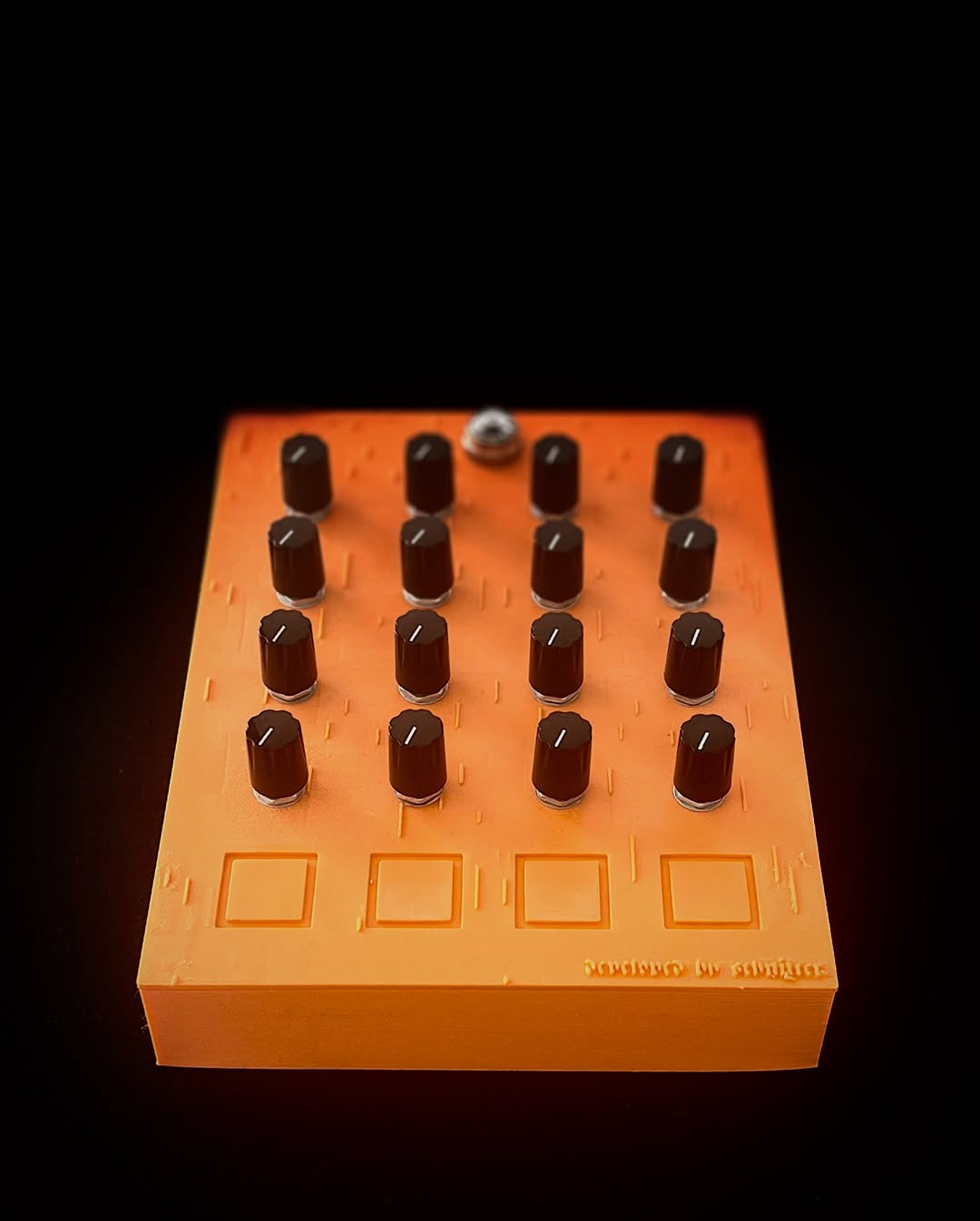
USB MIDI controller
Sixteen physical knobs multiplied across four capacitive-touch banks to control 64 MIDI CC parameters from one compact surface.
| Significance | First complete hardware project |
|---|---|
| Controller | Arduino Mega |
| Inputs | 16 knobs + 4 capacitive touch sensors |
| Addressable controls | 64 MIDI CC mappings |
| Firmware | C++ developed in Arduino IDE |
| Connection | USB Type-B for power and data |
| Enclosure | Custom 3D-printed housing |
(01)Starting point
GrimReach was my first complete device: the project where code, electronics, interaction, fabrication, and visual identity first had to meet inside one working enclosure.
The design targets software instruments and effects that expose far more parameters than a small physical controller can usually reach. Sixteen knobs offer immediate tactile access; four capacitive-touch sensors select control banks; and the same surface therefore addresses 64 different MIDI CC assignments.
(02)Control architecture16 physical / 64 logical
A / Surface
A four-by-four control matrix provides enough physical resolution for simultaneous adjustment while keeping every parameter within one hand’s reach.
B / Expansion
Four capacitive sensors switch the active MIDI layer. Each bank remaps the same sixteen knobs to a distinct set of controller numbers.
C / Capacity
The banked architecture multiplies a compact control surface into 64 addressable parameters without adding 48 more physical potentiometers.
D / Firmware
Code written in C++ and flashed through the Arduino IDE scans controls, tracks bank state, and emits the corresponding MIDI controller data.
E / Host
A USB Type-B connection carries both power and data. The controller can be mapped inside a DAW or plug-in to synths, effects, amplifier models, and mix parameters.
F / Mechanics
The orange 3D-printed housing organizes the grid, exposes the touch regions, supports the hardware, and gives the first build a distinct identity.
(03)Product thinking
The central tradeoff is density versus directness. Sixteen dedicated knobs remain visible and tactile; banking expands the reachable parameter set without making the enclosure impractically large. Touch sensing keeps bank changes quick and removes four additional mechanical switches from the surface.
GrimReach established the working method that shaped every later project. A successful prototype was not enough: the firmware had to behave reliably, the USB connection had to carry the complete experience, the enclosure had to be fabricated, and the final device had to be physically usable.
(04)Hardware recordClick to enlarge
The first build established the standard: finish the whole object.
GrimReach began the progression from a 64-control MIDI surface to analog audio circuits, configurable floor control, and finally the upgradable BonesFX embedded audio platform.